
Use cases
Same workspace, different uses along the workflow.
One team screens, another reviews, a third has to defend the result six months later. The workspace is the same. What each of them needs from it is not.
The deliverable, and what happens after it
for CROs and scientific service providers
Every study is single shot: the report lands in an inbox, the relationship goes quiet, and when they come back nothing carries over.
What changes
The deliverable comes out of the workspace where the work happened, and the client keeps a live surface into it afterwards. The second study inherits the first one's context.
Measured in pilot
Review-cycle time. Clarification rounds. Client interactions after delivery.
Scientists always ask bioinformatics for interactive figures, and bioinformatics has no time.
Sometimes it is hundreds of barplots to find one population difference.
What changes
They screen and chart themselves, without bioinformatics losing sight of what was done.
Measured in pilot
Expert hours per deliverable. Requests resolved without a round-trip.
Our clients can't tell our report from anyone else's, so we compete on price.
What changes
Everything the client sees traces to the work underneath, a difference they can check. And the figures come out in publication mode, ready for their paper or ours.
Measured in pilot
Figure-to-source traceability.
Version reconciliation, and cohort work at volume
for hospital and clinical translational teams · research use only
It is usual to have different interpretations on the same data.
What changes
Competing readings stay side by side and comparable, instead of forking into two slide decks.
Measured in pilot
Expert hours per deliverable. Clarification rounds.
After the analysis, there is no clear procedure.
What changes
Every step, including the paths tried and abandoned, is still there when someone asks.
Measured in pilot
Figure-to-source traceability.
Working together without handing over the data
for collaborating labs and cross-institution programmes
Working together stops at the first step, because neither side can hand over its data.
What changes
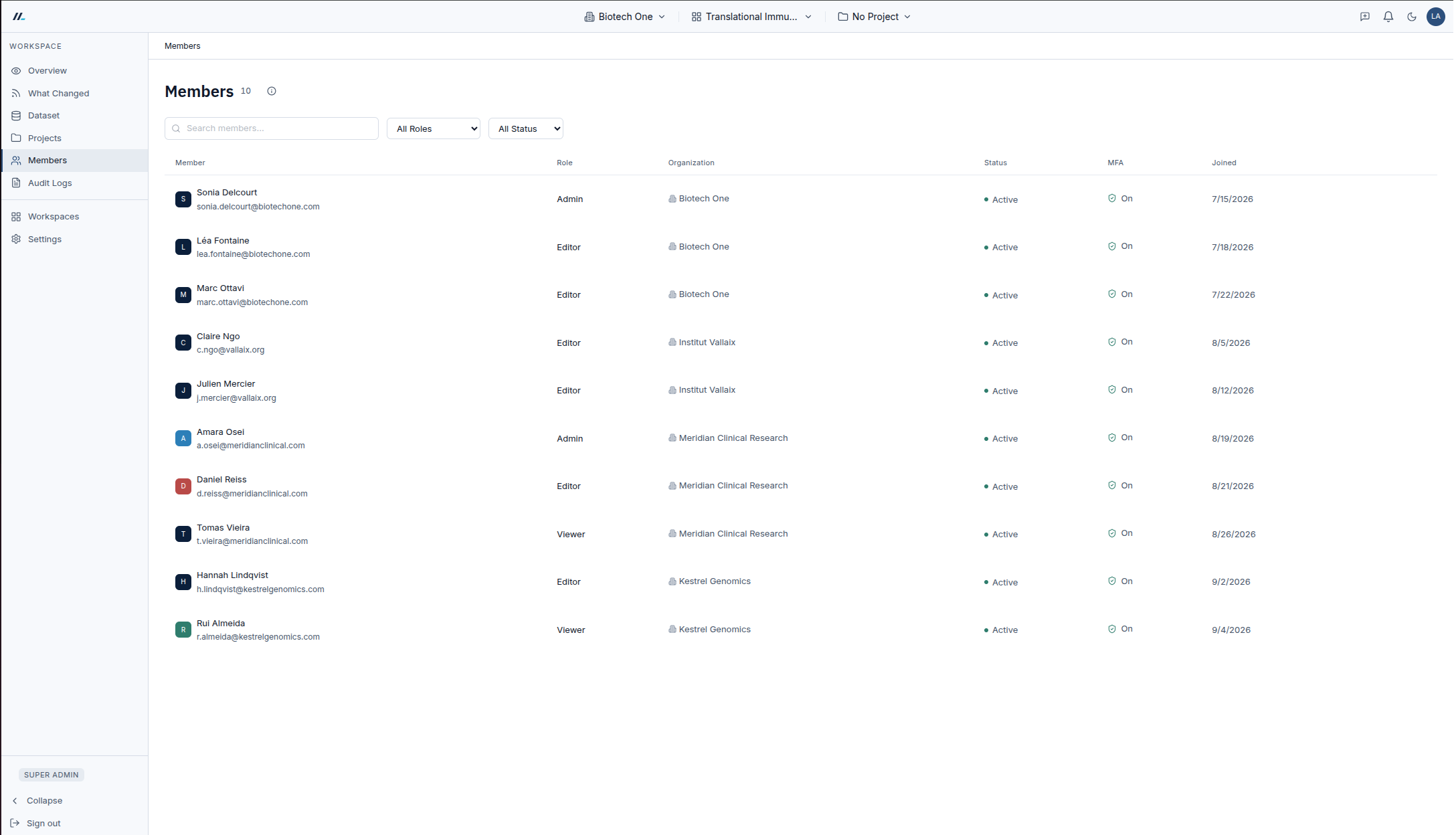
Members from each institution work in the same study under their own organisation, not as guests on one lab's account. Every project carries its origin. The work stays yours: you decide, per workspace and per project, who is in and what they see.
Measured in pilot
Clarification rounds. Share of review conducted inside the workspace.
Full security and data-protection detail → /trust
Never reconstruct anything
for biotech and translational teams
Data arrives in a first version. Weeks later new samples come in, and the analysis is redone.
What changes
New data does not mean starting again. The earlier conclusion keeps its context, and what changed is visible against it.
The reasoning that is not written down is the part you pay for twice.
What changes
Captured while you work, not written up afterwards. You are not documenting more, you are losing less.
Present the asset, survive due diligence
for teams presenting scientific value to sponsors, partners or investors
The scientific work is the value. What can be shown is figures and a narrative, and the reasoning that makes it defensible is not visible.
What changes
The record of how you got there becomes showable: versioned, attributable, inspectable.
Boundary
Axiome produces the record. It never outputs a clinical decision and does not certify anything.
The data room is a shared drive and loose files. When someone asks how a result was reached, the search starts.
What changes
Anyone can be walked through how a conclusion was reached, on the record, without depending on who is still employed.
Bring your own agent, keep the accountability
for teams being asked to put AI to work on scientific data
We're being told to use AI on our analyses, and nobody can tell us how we'd defend the output.
What changes
Work enters the record as a proposal carrying its signature, its parameters and its evidence. A person signs before anything leaves.
Our agents start from a folder of CSVs and whatever someone remembers.
What changes
They start from the signed record, and what they compute lands back in it.
We don't want to be locked to whatever AI our software vendor picked.
What changes
Bring the agent you already use. Axiome governs what it does, not which one it is.
Measured in pilot
Share of AI-assisted output reviewed inside the workspace. Figure-to-source traceability. Expert hours per deliverable.
Boundary
Axiome does not supply the model and does not draw the conclusion. It is where a machine's output becomes accountable.
Sentences recorded across discovery conversations with research groups, platforms and service providers, 2026. Published without attribution.
If your work is regulated but not translational, contract manufacturing, device or reagent production, this is the wrong shape and we will say so early. Axiome is for teams producing scientific interpretation from data, at volume.
Start with your own data.
We can work from your existing pipeline outputs, in your infrastructure. We can sign an NDA before anything is shared.