
Platform
Where the work happens after the analysis.
Axiome starts where your pipeline stops. Everything below is what your team can do in it.
Access was never the problem.
Data access is solved. FAIR is solved. We still can't reuse each other's conclusions.
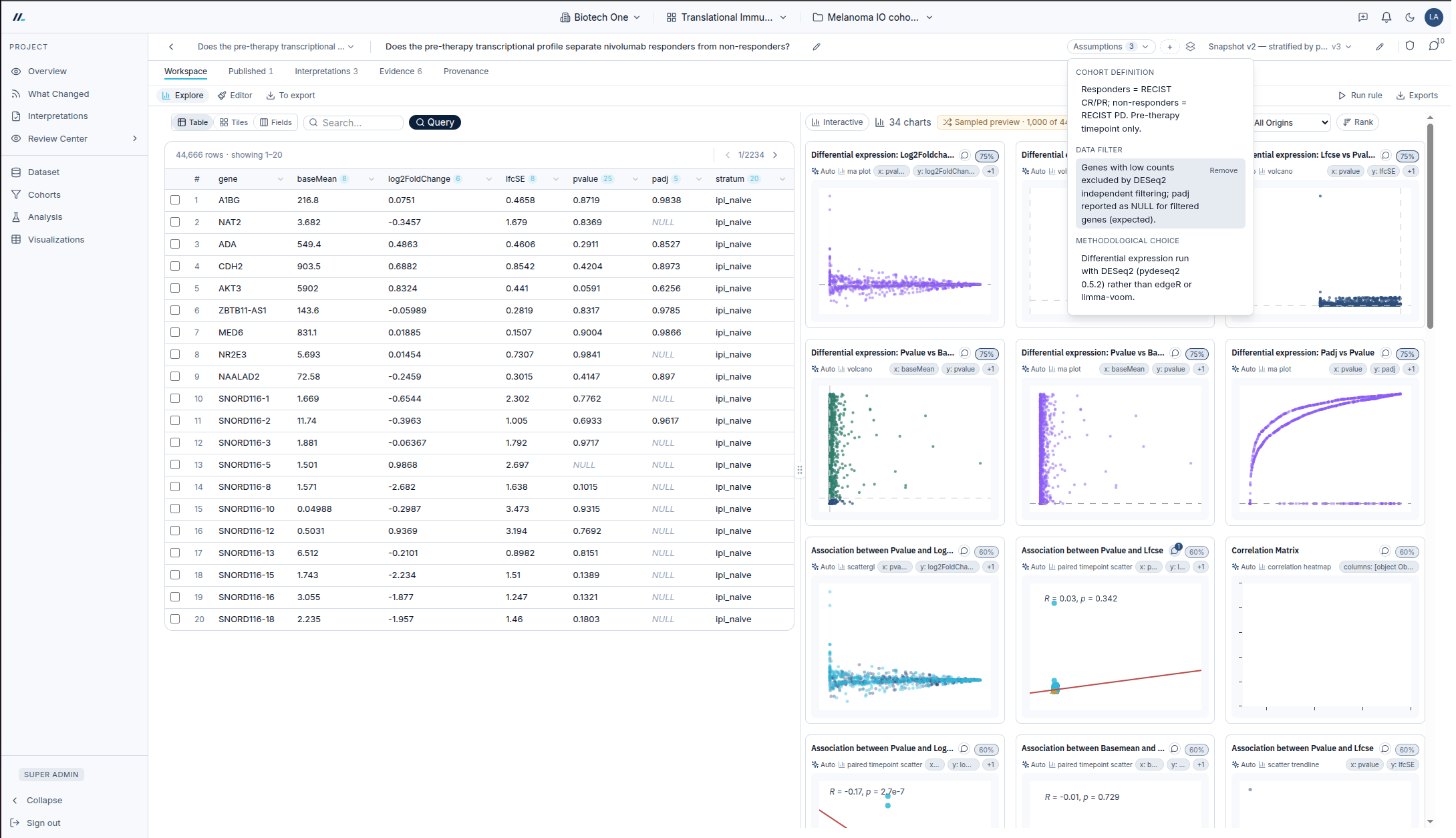
Axiome sits above your data platform, your pipeline, your analysis environment. It doesn't replace any of them and it doesn't compete with them. It holds the layer they all drop: what your team concluded, and why.
Findability gets you the result table. It doesn't get you the cohort you defined, the threshold you set and why, what you ruled out, or who signed off. Those are what a person needs in order not to start over. They are also what a machine needs.
Pipelines reproduce the analysis. Axiome versions and traces the conclusion.
How it works
From the table to the conclusion, in one place.
01
Bring the table
CSV, TSV, XLSX from RNA-Seq, flow cytometry, clinical and longitudinal analyses. Nothing gets ported.
02
Explore and chart
Screen the tables, compare groups, run the standard tests, build the charts. Without waiting on anyone.
03
Discuss on the figure
Comment on the chart itself, with everyone on the same version.
04
Decide, and keep what you ruled out
The path not taken stays in the record, so nobody re-runs it and nobody wonders why.
05
Sign
A named person signs the conclusion. The audit is generated from the work, not assembled at the end.
06
Hand over
What leaves carries its evidence, its author and where it came from. Your client, sponsor or partner is invited into it, not sent a file.
What's in it
Seven capabilities, all shipping.
Governed workspace
Biologists, bioinformaticians, clinicians and reviewers work on the same results, in the same version, each able to see what the others did and why.
Cohorts and screening
Define a group once, by rule, and it stays defined, named and versioned. Everyone works on the same denominator. Screen high-dimensional tables down to what matters.
Charts that stay attached to their data
Every point links back to the row it came from. Click it and the evidence is there, checkable on the spot: not a picture of a result, the result. Switch to publication mode and the same chart is ready for the paper.
Domain rules
Bring the criteria your team already works to, from a published protocol or from your own practice, and enter them once as versioned rules. Each application is recorded: which version of which rule, against which values, by whom and when. Where a criterion needs judgement, Axiome presents it and records your determination rather than making it. Axiome does not supply the rules and does not validate them. Your experts do.
Versioned statistical checks
Descriptive statistics, group comparisons, paired before and after tests, significance testing. Deterministic, reproducible, single-answer, with method, parameters, author and history recorded. Complements your pipeline; does not replace it. The platform runs the analysis, you operate it, and the person who knows the science signs the conclusion.
Sharing outside the team
Invite a sponsor, a client, a partner lab or a second centre into the work, scoped to what they should see. They get a workspace, not a PDF in an inbox: the finding, the evidence it rests on and its version history, without your working files or your internal discussion. Whatever leaves, a chart, a figure, an export, carries where it came from.
Working across institutions
A study can carry members from several organisations in the same workspace, each under their own organisation rather than as a guest on someone else's account. Every project shows the organisation it came from. The work stays yours: you decide, per workspace and per project, who is in and what they see.
Questions teams ask before they start → /faq
What travels with a conclusion.
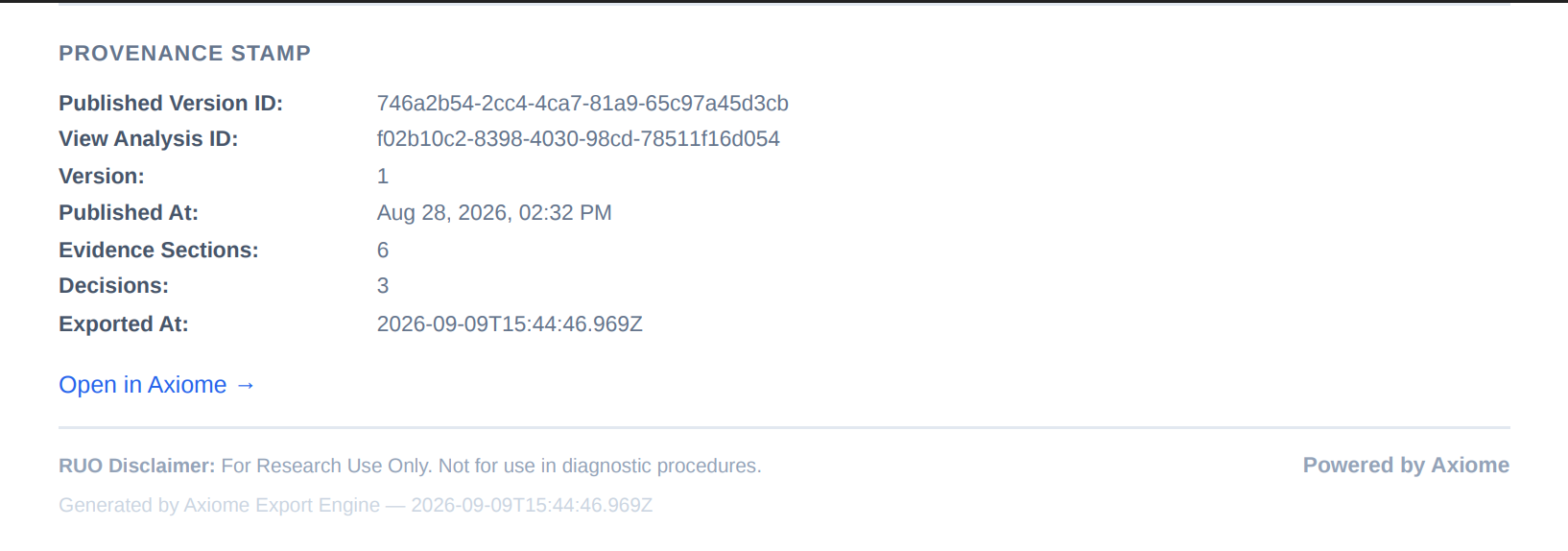
Provenance stamp
On everything that leaves, including the PDF. The document carries where it came from.
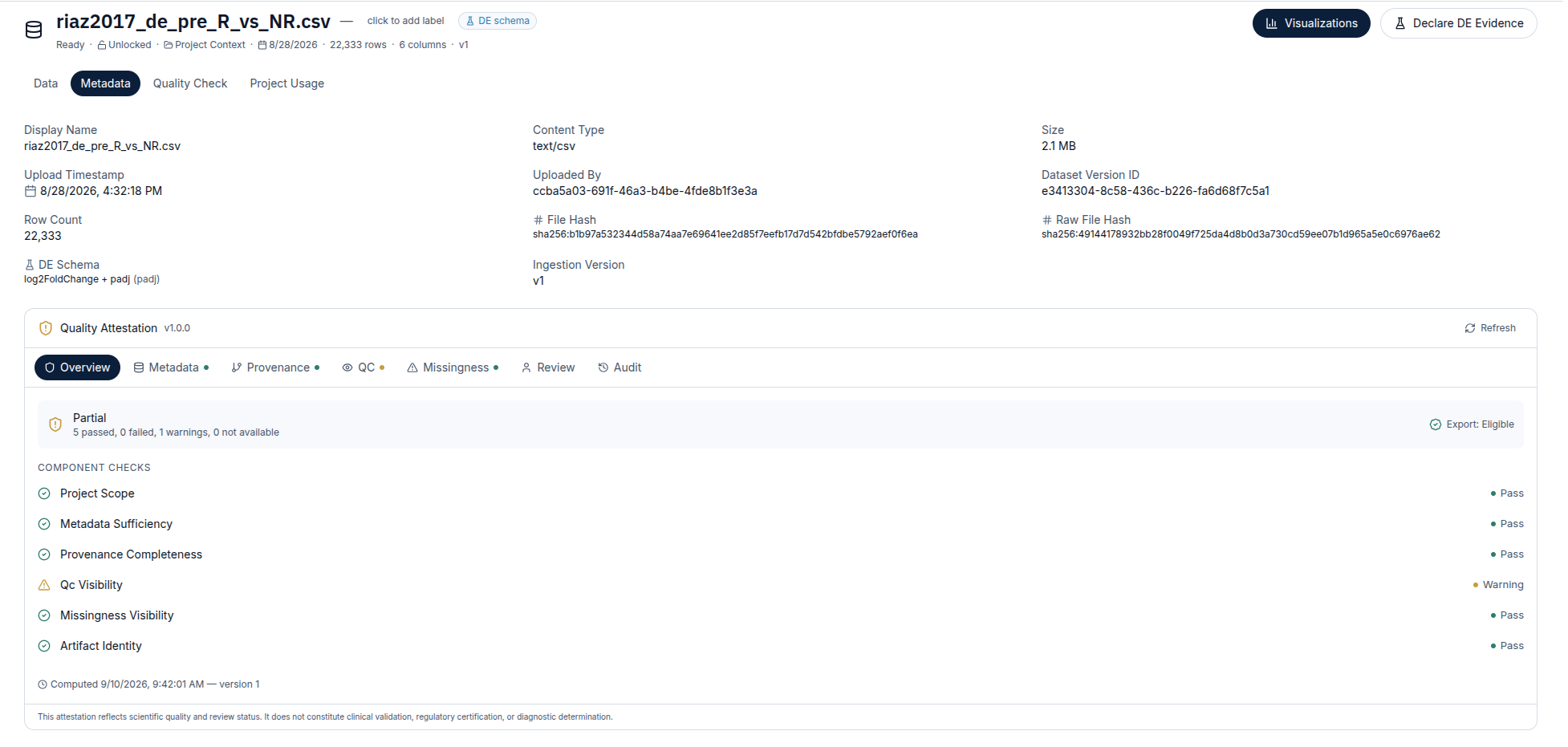
Quality attestation
What was checked before the conclusion was signed, with each check named and its result shown.
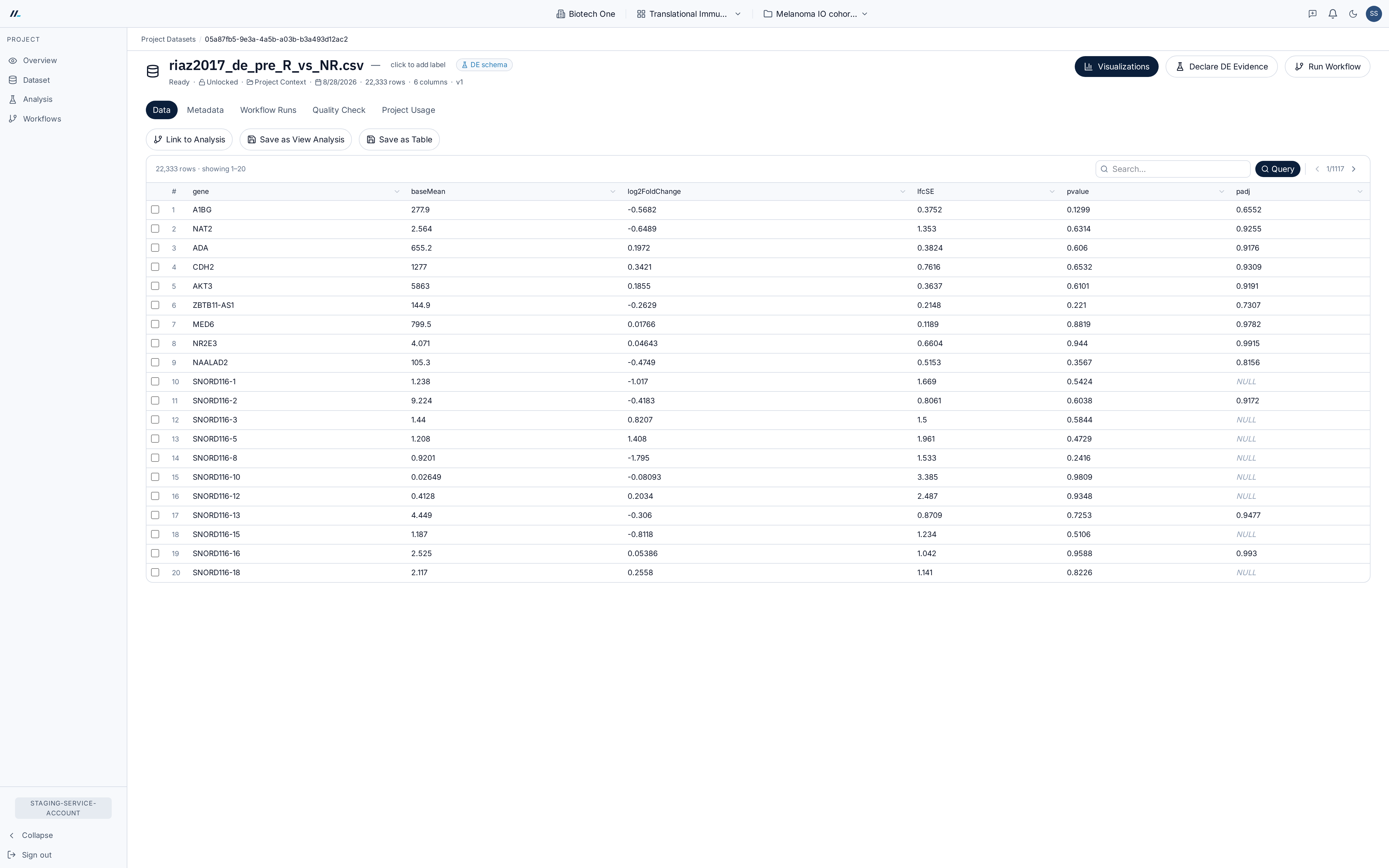
What each column actually is
A DE table is recognised as a DE table, a flow export as population frequencies. Not a generic CSV.
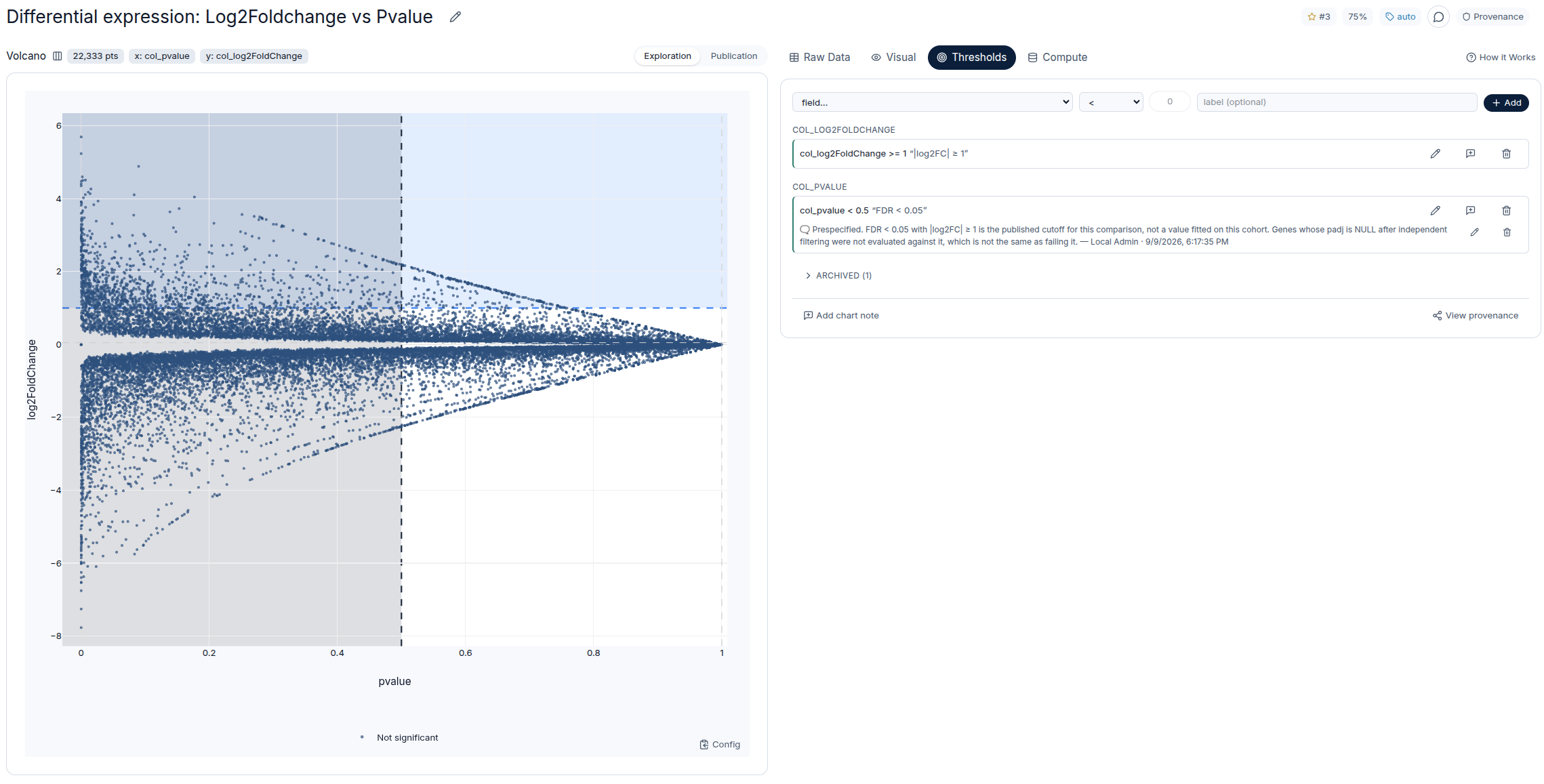
Why that threshold
Every cutoff carries the reason it was set and the person who set it, not just the number.
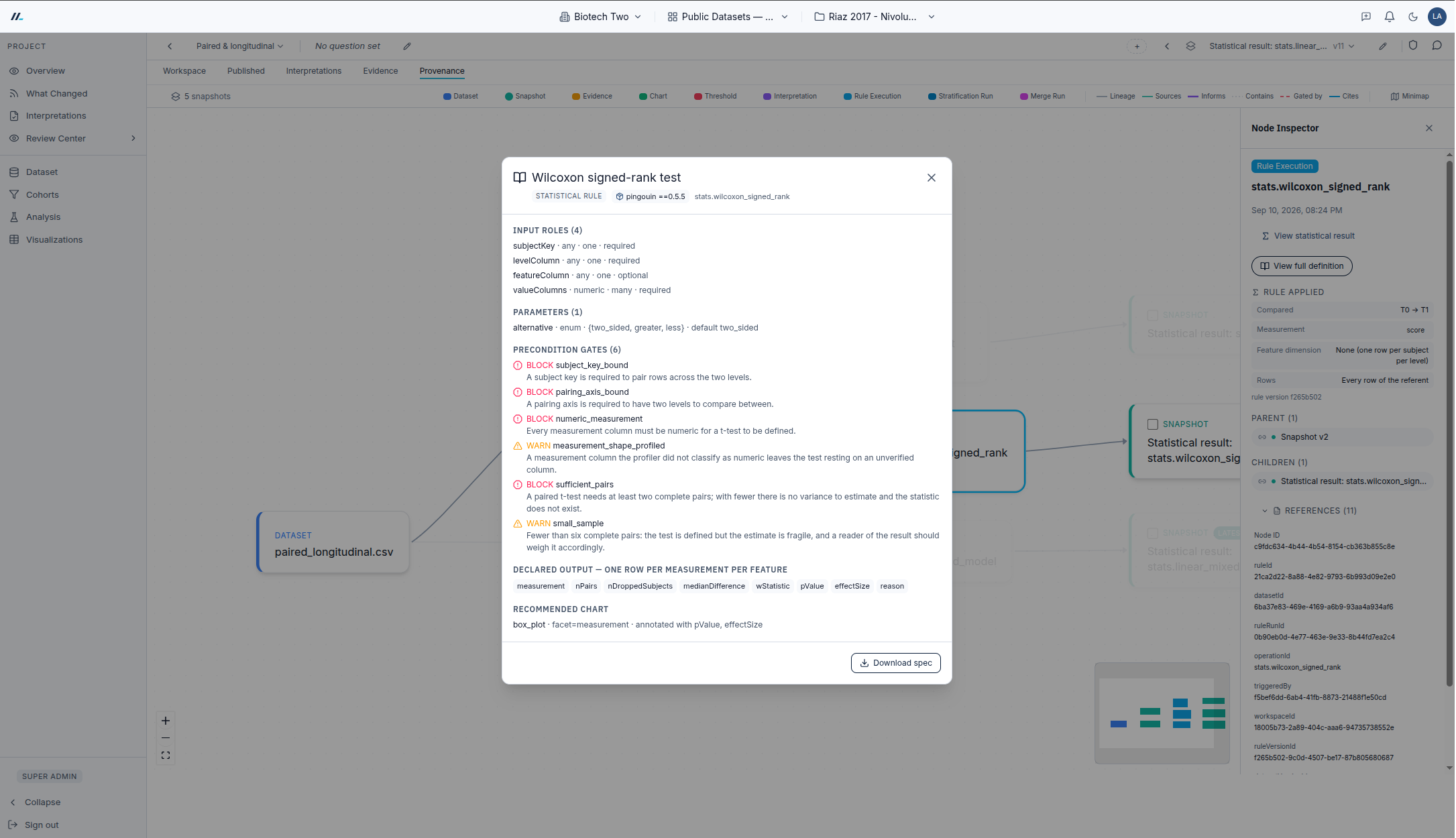
The statistical record
Method, parameters, thresholds, author, and the version of the library that produced it.
Institutional memory a machine can read.
The record accumulates. Cohort definitions, thresholds with their rationale, signed conclusions with their evidence: named, versioned, structured rather than filed. Someone joining eighteen months later starts from what the team established.
So does an agent. Bring your own: it reads the record, works in it, and runs the platform's statistical checks under its own account and its own signature, scoped to what it may see. It runs the statistics in the record, not beside it. A result computed here arrives with its method, parameters, inputs and author attached, because that is where it was computed.
An agent proposes and cannot approve. A person signs. It gets the same accountability as a colleague and one right fewer. An agent can't make an unsupported claim in Axiome, because a claim without its evidence isn't a valid object in the record.
Axiome does not supply the model and does not draw the conclusion. Whether a conclusion already reached still applies to new data is not something it answers today.
What it works with.
Data
RNA-Seq, single-cell RNA-Seq, flow cytometry and CyTOF, clinical and longitudinal tables. CSV, TSV and XLSX exports from your existing pipeline. Nothing gets ported.
Statistics
Descriptive statistics, group comparisons, paired before and after tests, standard significance testing. The analyses you already know you need, run in the platform, with method and parameters recorded alongside the result.
Where complex analysis stays
Custom modelling and heavy bioinformatics stay with your team. Their outputs come back into the same workspace.
Three things you can point at.
The context
Every interpretation carries its cohort definition, its filters and its methodological choices.
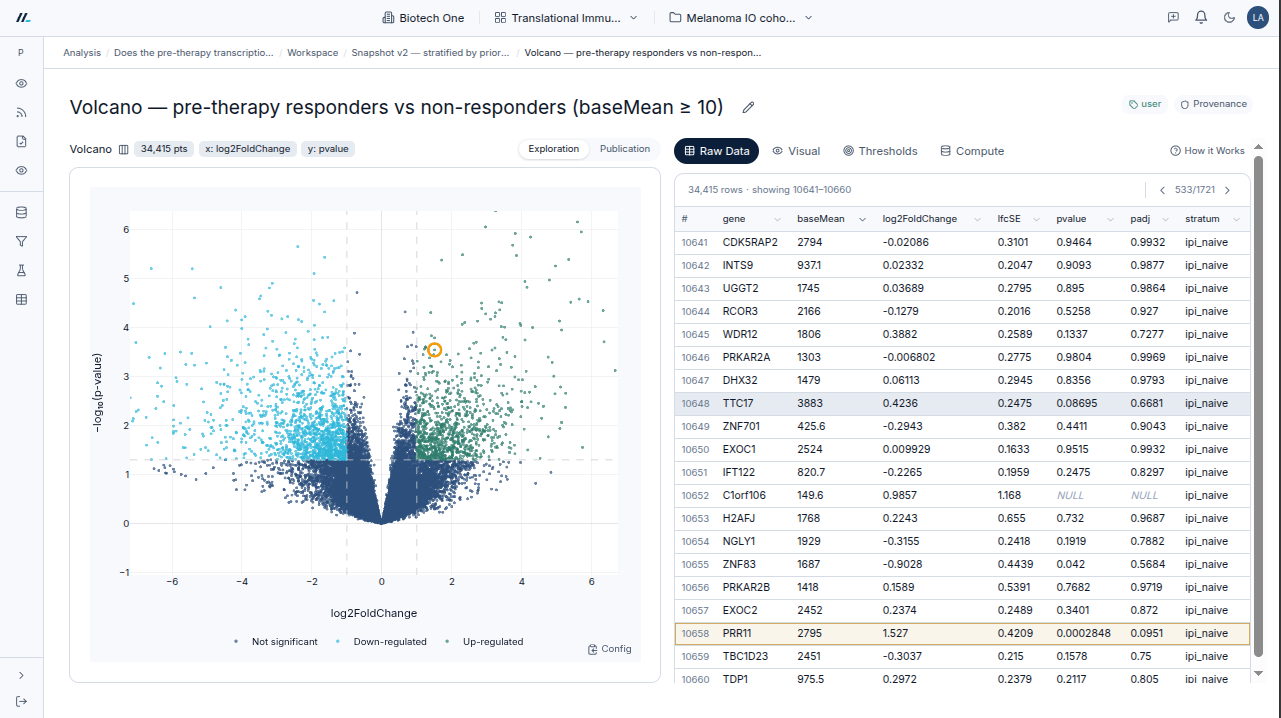
The evidence
Each conclusion is linked to its proof. Every point links to its data; the evidence is checkable on the spot.
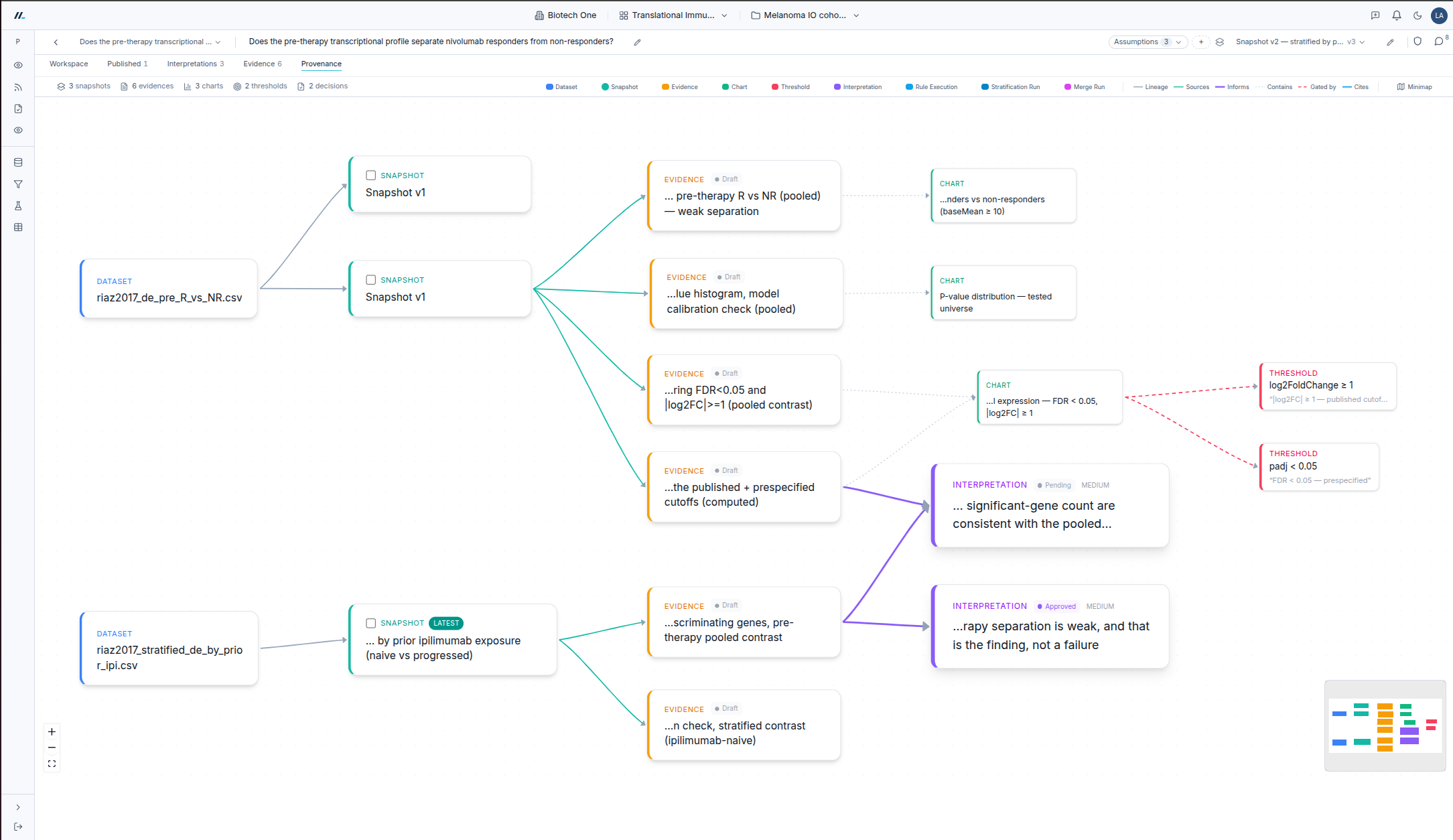
The trail
From dataset to validated interpretation: filters, thresholds and versions, all traced.
Hosting
HDS-certified infrastructure in France. EU data residency.
Tenancy
Multi-tenant with strict segregation between organisations. GDPR-compliant, role-based access.
Expertise
Software engineering, bioinformatics, cloud architecture and interface design for scientific work. Built by people who have shipped regulated clinical software before.
Full security and data-protection detail → /trust
Start with your own data.
We can work from your existing pipeline outputs, in your infrastructure. We can sign an NDA before anything is shared.